
Dans le cadre de la Semaine mondiale de la vaccination 2022,Ma Cliniques’entretient avec le Dr Ruanne Barnabas au sujet de l’étude KEN She qui a révélé qu’une vaccination à dose unique contre le virus du papillome humain (VPH) était efficace pour prévenir l’infection oncogène persistante par le VPH.
Sommaire
Pouvez-vous vous présenter, nous parler de votre parcours en épidémiologie, ainsi que de ce qui a inspiré vos dernières recherches ?
My name is Ruanne Barnabas. I am a physician/scientist in infectious diseases, and I’m currently the Chief of Infectious Diseases at Massachusetts General Hospital and faculty at Harvard Medical School.
There are two main inspirations for doing the study. One is that we can expect cervical cancer to be eliminated as a public health burden in Australia in the next few years. It’s very rare in medicine that we have a silver bullet, but the human papillomavirus vaccine is a silver bullet. It’s a near-perfect vaccine that almost entirely prevents infection and prevents persistence and progression to cervical cancer. It has immense effects throughout populations. We’ve seen decreases in genital warts, and we can expect in countries with high vaccination coverage that we will eliminate cervical cancer as a burden of disease. There has also been very good evidence that a single dose had very high efficacy.
The other main inspiration was what an awful disease cervical cancer is. It’s often diagnosed late. It often requires both surgery and chemotherapy, and it is a disease that affects women in the middle of their lives. The cost, both economic and social, of women dying early from cervical cancer, a completely preventable disease, it’s just so sad to see.
I visited the cervical cancer ward at the Kenyatta National Hospital in Kenya with my colleague, Nelly Mugo. Every person who was there did not need to be in that ward. They had access to both surgery and radiotherapy, which is great, but they didn’t have access to a safe blood supply. So many people had delayed treatment while waiting for blood supply. It’s heartbreaking to see that.
So thinking about how we can reboot the HPV vaccine efforts, the coverage for HPV vaccine globally is 15%. Over the pandemic, the coverage has fallen to 13%. The vaccine has been available for more than 15 years. We need to do more, and we need to do it faster. There have been some supply constraints as well. So single dose would mean that more people are protected. Although there was lots of good observational evidence of the efficacy of a single dose, there was no good data from randomized control trials, the goal standard. We felt if we could do that and do it quickly, that could make a difference and reboot the HPV vaccine field.
Human papillomavirus (HPV) is a very common virus, and most sexually active individuals will become infected in their lifetime. Could you tell us about the epidemiology of HPV and the current disease burden it causes globally?
Most people acquire HPV with sexual debut, and the peak incidence is around age 15. Most infections clear spontaneously, but some persist and then progress onto cervical cancer. The burden of cervical cancer is very unevenly distributed. In Kenya, for example, the incidence of cervical cancer is 45 per 100,000 women. In the US, it’s seven. In Australia, it’s approaching less than two per 100,000 women. So the burden of cervical cancer is felt in low- and middle-income countries.
80% of the burden of cervical cancer is in low- and middle-income countries without good access to screening and limited access to vaccination. Papua New Guinea, Asia, and South America are other key areas where cervical cancer continues to have a disproportionate effect on cancer burden. In many low- and middle-income settings, it’s the leading cancer among women.
The current standard for women is a three-dose regimen. Which vaccines are used, and what are the current challenges the multi-dose regime presents?
The current standard is two doses for nine to 14-year-olds and then three doses for 15-year-olds and above. The challenges are, it’s a vaccine given in adolescence, and there’s no good platform for vaccines in adolescents. You have to ensure that the doses are given to the same person in a certain amount of time, so you need the tracking, which is labor-intensive. The vaccines are usually administered by nurses who could be doing other things with their time. Then there has been a shortage of vaccines as well.
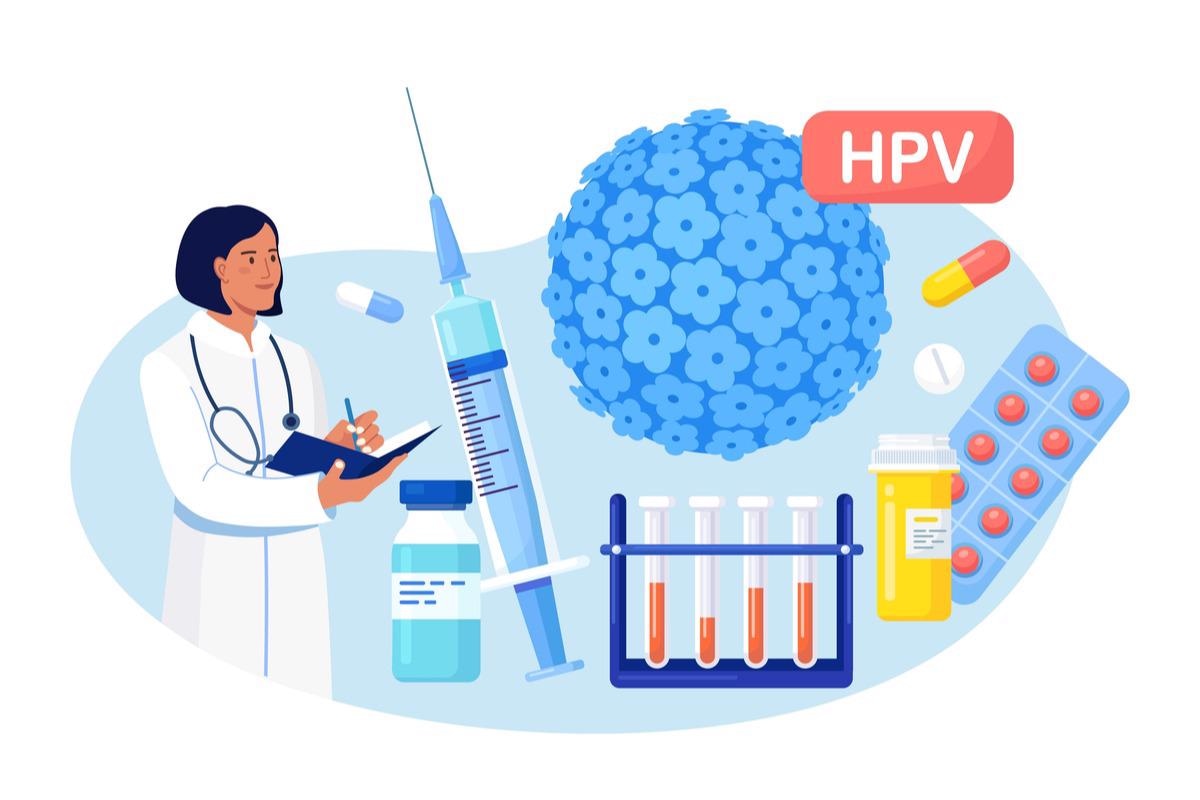
Image Credit: Buravleva stock/Shutterstock
Given that nine out of 10 HPV infections resolve on their own in two years, what impact do vaccine hesitancy and the belief the body doesn’t need HPV vaccination have on uptake?
Yes. I think that vaccine hesitancy around the vaccine can affect uptake, but it’s our job to communicate the larger goal here that we could eliminate cervical cancer. This could also mean a decrease in the amount of screening that people need to have in later life. The benefit of eliminating HPV for all of us is to take cervical cancer off our concerns for the burden of disease. That’s where we want to focus our time and energy. We have excellent observational data showing that when HPV vaccine coverage is high, you see dramatic decreases in genital warts, persistent HPV lesions, and precancer lesions.
The KEN SHE Study investigated the efficacy of a one-dose HPV vaccine. Could you tell us about the trial, how it was conducted, and the main findings?
The study was conducted at three sites in Kenya: Kisumu, Thika, and Nairobi. We enrolled 2,275 sexually active young women between the ages of 15 and 20. Participants were randomized to receive either immediate HPV vaccine or delayed HPV vaccine. In the delayed group, they received the meningococcal vaccine immediately. In the immediate HPV group, they received the delayed meningococcal vaccine. We followed participants every six months and tested for HPV. There were three arms to the study. Participants could receive the bivalent vaccine, which protects against two high-risk types, the nonavalent vaccine, which protects against seven high-risk types and two types that cause genital warts, or they could receive the meningococcal vaccine and then later HPV.
We tested every six months, and we found that protection against HPV 16 and 18 had a high efficacy of 97.5%. This result was stable in many other analyses. We also found very high protection against the seven high-risk types (88%). When we did the analysis in the same way that it’s done for clinical trials for the vaccine, excluding people who had an infection at month six, we found 100% efficacy for the bivalent and nonavalent vaccine against 16 and 18, and 95% efficacy against the seven high-risk types in the nonavalent vaccine.
Considering 90% of cervical cancer cases are in low- and middle-income countries, how may a one-dose regimen help eradicate the disease in these countries?
We were thrilled to see the guidance from SAGE and WHO recommending either one or two doses for HPV based on the strength of the evidence. This would simplify the vaccination campaigns, and it would also mean that more people could be vaccinated. The vaccination rate fell during the pandemic. We have many young women out there who still need to be vaccinated.
Image Credit: SewCream/Shutterstock
This year’s World Immunization Week theme is a « Long Life for All. » What does a « Long Life for All » look like to you, and what role does immunization play in such a life?
This is a great question. It makes me think about what public health should be. Ideally, public health is in the background, something that happens quietly and allows people to focus on more important things in their lives; relationships, families, work, and community life. In a long life for all, we would have well-functioning healthcare systems that are able to deliver client-centered care and that are flexible and respectful of patients and clients.
For secondary prevention, accessing screening, possibly receiving an abnormal screening test, and then being treated still have all the burden of screening, the anxiety around screening.. I would like to take that away because we have this perfect vaccine that will prevent that. People should have access to vaccines, have their concerns understood, and have good communities and stakeholders who help them access the vaccines without stigma or without expectations that make it difficult to be vaccinated.
As a society, how can we work towards global vaccine equity and strive towards a « Long Life for All »?
I think the most important thing to consider is « who is at the table? ». When we reboot HPV vaccination and think about global vaccine equity, who is at the table to help us reach this goal? Who are the stakeholders? We want to have shared agendas and have equity at the heart of what we do so that when we have a product that works and that works perfectly, we don’t have to do another step for demand creation because the demand creation was built into the discovery, the translation, and the testing.
Looking to the future, are there any other vaccine-preventable diseases that would particularly benefit from a single-dose vaccination regimen?
Certainly, for Hepatitis A, we now know we have evidence that one dose is sufficient. During a yellow fever outbreak, a trial of fractional dosing for the yellow fever vaccine showed high efficacy. I think we should think about fractional dosing, so even less than one dose, to try and ensure that all eight billion people on the planet are vaccinated and decrease the overall burden of disease.
What is next for you and your research?
For the KEN SHE Study, we’re going to look at the durability of the vaccine. That’s a really important question that we need to answer. My other work in HIV is around community-based interventions and thinking about how to make things accessible. But really, the most important thing for me in the next step of my research is to think about the ripple effect that I could have. Mentoring new investigators is the most important thing that I will do next.
Où les lecteurs peuvent-ils trouver plus d’informations ?
À propos du Dr Ruanne Barnabas
Le Dr Ruanne Barnabas est un médecin scientifique sud-africain et le chef de la division des maladies infectieuses au Massachusetts General Hospital (MGH).
Au cours des 15 dernières années, ses recherches se sont concentrées sur les interventions pour le traitement et la prévention du VIH et des MST, et, plus récemment, sur la prévention du COVID-19. Elle s’intéresse particulièrement aux nouvelles approches qui augmentent l’accès aux services et a mené des essais cliniques avec une modélisation économique de la santé complémentaire pour évaluer l’impact potentiel des interventions comme, par exemple, dans l’étude sur l’optimisation de la livraison de la thérapie antirétrovirale (DO ART), qui évalue la l’efficacité et le rapport coût-efficacité de l’initiation décentralisée du TAR à base communautaire par rapport aux soins en clinique. Elle dirige également des travaux d’évaluation de stratégies innovantes pour accroître l’accès aux soins, y compris les incitations à la loterie et la livraison à domicile et le suivi des ART. Elle est présidente du protocole de l’étude KEN SHE visant à évaluer l’impact de la vaccination à dose unique contre le virus du papillome humain (VPH) au Kenya. Récemment, son travail s’est étendu à la prévention du COVID-19 au sein des ménages. Le but ultime de son travail est d’identifier des stratégies efficaces et évolutives de traitement et de prévention du VIH, du VPH et des maladies infectieuses afin d’accroître l’accès dans diverses communautés et de promouvoir l’équité en matière de santé.
En plus de diriger des essais cliniques et de la modélisation économique de la santé complémentaire en tant qu’investigatrice financée de manière indépendante, elle est également conseillère auprès de l’Organisation mondiale de la santé et de l’ONUSIDA sur l’élimination du cancer du col de l’utérus et le traitement et la prévention du VIH. Elle fait partie du comité de planification de la conférence AIDS 2022. Elle a été honorée en tant que membre de l’Infectious Diseases Society of America en 2020. Elle a plus de 130 publications évaluées par des pairs.
Le Dr Barnabas est diplômée de l’Université de Cape Town, en Afrique du Sud, où elle a obtenu son diplôme de médecine. Elle a obtenu son doctorat de recherche en médecine et en épidémiologie clinique de l’Université d’Oxford, où elle était boursière Rhodes. Elle a terminé sa résidence en Afrique du Sud et sa bourse en maladies infectieuses à l’Université de Washington où elle a rejoint la faculté et a été promue professeur de santé et de médecine mondiales avant de rejoindre le MGH en janvier 2022.